Swift Burned Up Over Sumatra. 7,000 Papers Remain.
NASA's gamma-ray hunter died on reentry Wednesday, Nov. 4. The archive it leaves behind, including a 2008 ultraviolet portrait of Andromeda, is what actually pays the mission's bill.
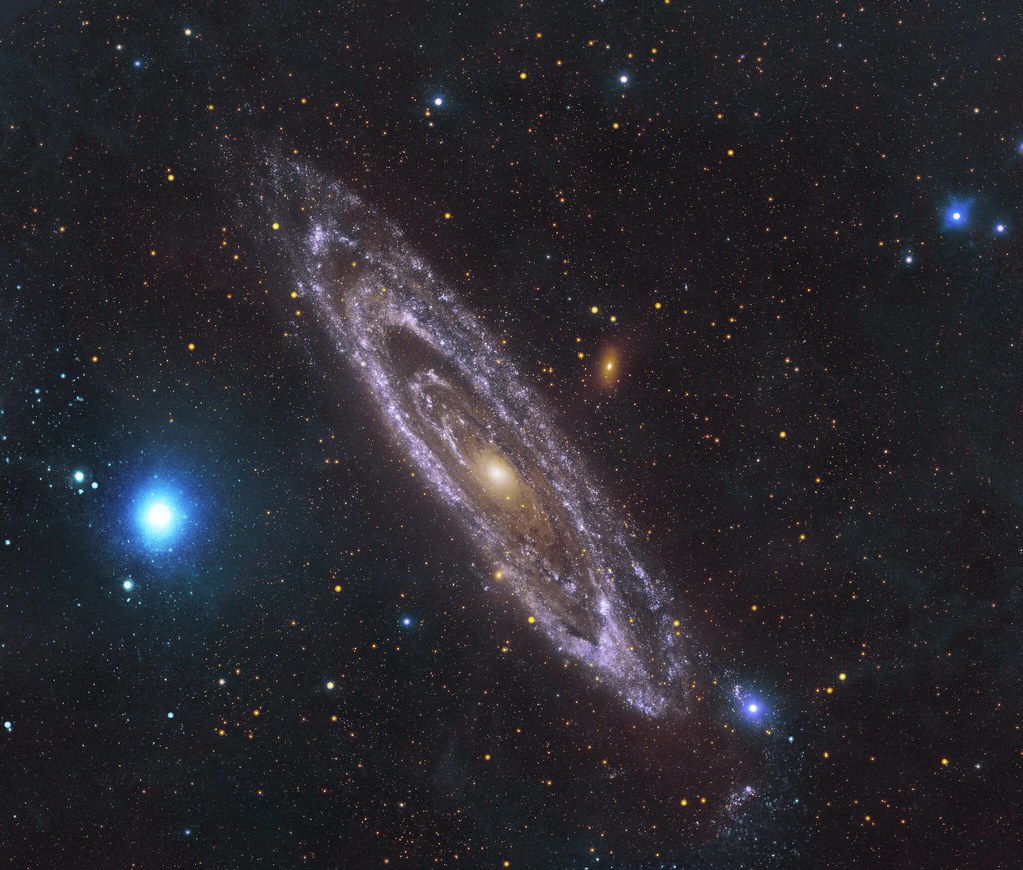
The Andromeda galaxy making the rounds online this week was photographed by a telescope that no longer exists. That's not a metaphor. The instrument that captured it burned up in the atmosphere days before the image went viral.
NASA's Neil Gehrels Swift Observatory re-entered Earth's atmosphere on Wednesday, Nov. 5, ending 22 years of studying the most powerful explosions in the cosmos. NASA put the re-entry point at about 3.4 degrees north latitude and 98.6 degrees east longitude, over North Sumatra. We covered the setup on Tuesday, Nov. 3, when the only question left was where the debris would land, not whether the mission mattered.
It mattered. The consensus take on a dead satellite is simple: the instrument is gone, so the story is over. That consensus is wrong, and the numbers NASA itself put out say so.
The photo is old. The archive isn't.
The Andromeda image circulating now is not new. It's a 24-hour exposure captured over two months from May to July 2008. It resurfaced because the hardware that took it just stopped existing, not because anyone discovered something new in it.
That's the actual point. The Swift archive contains nearly 22 years of brightness measurements of cosmic outbursts, multiwavelength spectra, more than 1.5 million images from its Ultraviolet/Optical Telescope, and more—publicly available, spanning approximately 12 terabytes. A satellite is a one-time capital expense. An open archive is a royalty stream that never stops paying.
The bill that already got paid
In its career, Swift observed more than 2,000 gamma-ray bursts, studied more than 1,400 supernovae, witnessed stars shredded by black holes, monitored active galaxies, and conducted an all-sky X-ray survey. Some 7,000 published scientific papers built off Swift data.
That number does not reset to zero because the hardware is ash over Indonesia. Every one of those papers still exists, still gets cited, and the archive behind them still takes new queries from any researcher with an internet connection.
Translation: when NASA's astrophysics chief says the mission "played a major role in advancing humanity's understanding of the universe," he's not doing eulogy spin. A mission built for two years that ran eleven times longer and seeded 7,000 papers is not a sunk cost. It's the rare government program that hit its return on investment and then kept compounding.
None of this erases the operational failure underneath it. NASA spent $30 million on a single rescue contractor with no backup plan, and that bet failed in August. The reentry doesn't fix that decision. But it proves the decision cost less than it looked like it would: the instrument was replaceable risk, the dataset was not, and NASA protected the right half whether it meant to or not.
What to watch: whether NASA treats the Swift playbook—one contractor, no parallel track—as a lesson or a one-off the next time an aging, irreplaceable observatory starts losing altitude. The archive survives regardless. The next $500 million instrument in a decaying orbit might not get the same lucky ending.
- NASA's destroyed Swift Observatory took one of the best-ever photos of bright Andromeda — Space photo of the week
- NASA observatory falls out of orbit, burns in atmosphere after 22 years of studying the cosmos
- NASA's Swift Mission Ends, Leaves Behind Scientific Bonanza
- NASA Swift Telescope Crashes Back to Earth After 22 Years
- NASA's Swift, Now Burned Up, Mapped 20,000 UV Sources in Andromeda
- NASA's Swift Telescope Burns Up Over Sumatra After 22 Years in Orbit
- APOD: 2026 November 6 - A Farewell to Swift - NASA Science
- M31_Layered_UV_and_Optical.tif - NASA Science
- Swift: the science across the rainbow. Mission Overview and Highlights of Results
- NASA’s 22-Year-Old Swift Satellite Falls Back to Earth Over Indonesia - Oneindia News
- AT2022aedm and a new class of luminous, fast-cooling transients in elliptical galaxies
- Discovery of a Featureless Tidal Disruption Event at z~1 with the Wide Field Survey Telescope
- NASA’s Swift telescope to fall back to Earth after 21 years in orbit
- 4th TDAMM Workshop White Paper
- The Constant Evolution of the Neil Gehrels Swift Observatory: Two Decades of Operational Innovation for Time-Domain and Multi-Messenger Astrophysics
- Swift follow-up observations of candidate gravitational-wave transient events
- Where Pieces of NASA's Swift Observatory May Crash This Week
- Observatories in Space